
Pan African University Institute for Basic Sciences, Technology and Innovation
I am a PhD in Electrical Engineering specializing in wireless communications, artificial intelligence, and large-scale optimization. My research focuses on reinforcement learning and data-driven approaches for decision-making in complex, high-dimensional and distributed systems, with applications to next-generation (5G/6G) communication networks.
I am particularly interested in designing scalable, robust, and efficient algorithms for resource allocation under uncertainty, as well as in bridging learning-based methods with classical optimization techniques. More recently, I have developed an interest in integrating reinforcement learning with large language models for intelligent decision support in complex systems.
Alongside my research, I am a university lecturer and trainer, delivering practical courses in data science, Python, and software development. I enjoy translating complex theoretical concepts into real-world applications and helping learners build strong, industry-relevant skills.
I am open to collaborations in AI, optimization, and intelligent systems, as well as opportunities to contribute to impactful research and innovation.
Warning
Problem: The current name of your GitHub Pages repository ("Solution: Please consider renaming the repository to "
http://".
However, if the current repository name is intended, you can ignore this message by removing "{% include widgets/debug_repo_name.html %}" in index.html.
Action required
Problem: The current root path of this site is "baseurl ("_config.yml.
Solution: Please set the
baseurl in _config.yml to "Education
-
 Pan African University Institute for Basic Sciences, Technology and Innovation (PAUSTI)Ph.D. in Electrical Engineering (Telecommunications)
Research focus: Deep Reinforcement Learning for resource allocation in cell-free massive MIMO networksApr. 2023 - Apr. 2026 -
 University 20 August 1955, SkikdaM.Sc. in Electrical Engineering (Telecommunications Systems)Nov. 2019 - Jul. 2021
 -
University 20 August 1955, SkikdaB.Sc. in TelecommunicationsNov. 2016 - Jul. 2019
Experience
-
Pan African University Institute for Basic Sciences, Technology and Innovation (PAUSTI)PhD Researcher
Deep Reinforcement Learning for large-scale wireless system optimization2023 - 2026 -
 IMPERIS Sarl, BamakoTelecommunications Engineer
Optical networks and microwave systems deploymentDec. 2022 - Apr. 2023 -
 Orange MaliTechnical Intern – Network Engineering
FTTx deployment and wireless network implementationSep. 2022 - Nov. 2022 -
 École Universitaire de Technologies et de Gestion (EUTG), BamakoPart-time Lecturer (Programming & Algorithms)2022
 -
 Institut Supérieur des Affaires et de Technologies (ISPATEC), BamakoPart-time Lecturer (Electronics & Systems)2021 - 2023
Honors & Awards
-
Algeria–Mali Cooperation Scholarship (Excellence Award)2016
-
Pan African University (PAUSTI) Scholarship2023
News
Selected Publications (view all )
Optimizing uplink power control for energy efficiency in mmWave user-centric cell-free massive MIMO with deep reinforcement learning
Dramane Diarra, Heywood Ouma Absaloms, Philip Kibet Langat
Journal of Engineering and Applied Science 2026
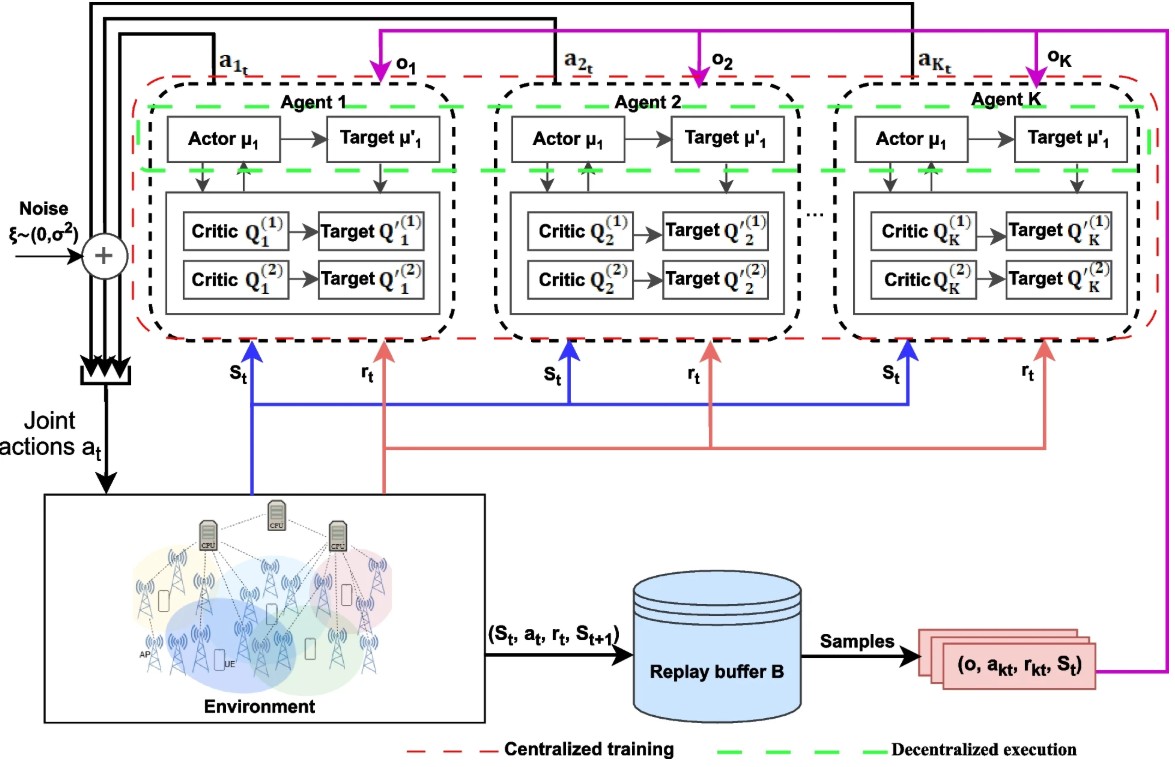
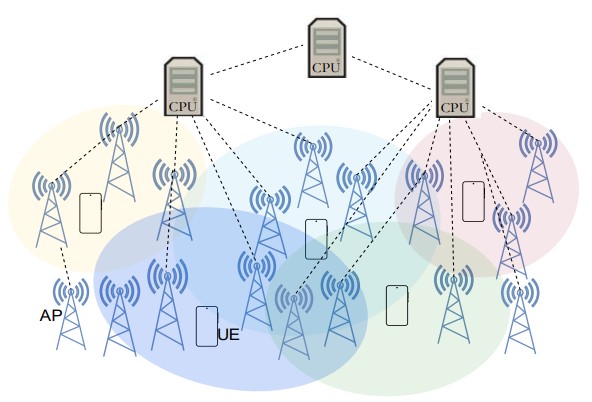
User-centric (UC) Cell-Free massive Multiple-Input Multiple-Output (CF-mMIMO) millimeter-wave (mmWave) networks are a promising solution to meet the performance requirements of next-generation wireless systems. However, maximizing energy efficiency in dense deployments remains challenging due to coordination overhead and highly dynamic propagation conditions. This work addresses uplink power control in UC CF-mMIMO networks and proposes a Multi-Agent Twin Delayed Deep Deterministic Policy Gradient (MATD3) approach trained under a centralized training and decentralized execution (CTDE) paradigm. The simulations are performed in a PyTorch library and rely on 3GPP TR 38.901 specification for the mmWave channel model over a UC architecture with 35 user equipments (UEs) and 100 distributed access points (APs). Simulation results indicate clear gains over both DRL baselines and conventional optimization methods. In particular, the proposed scheme reaches an energy efficiency of up to 380 Mbit/joule and maintains spectral efficiencies above 18 bps/Hz. Moreover, the method also preserves user-level reliability with a median minimum per-user spectral efficiency remains above 9 bps/Hz, and the Jain fairness index reaches 0.96, preventing resource starvation while maintaining strict QoS guarantees. These findings demonstrate that multi-agent cooperation enables robust and energy-efficient power control policies, paving the way for cost-effective and scalable UC CF-mMIMO deployments.
Optimizing uplink power control for energy efficiency in mmWave user-centric cell-free massive MIMO with deep reinforcement learning
Dramane Diarra, Heywood Ouma Absaloms, Philip Kibet Langat
Journal of Engineering and Applied Science 2026
User-centric (UC) Cell-Free massive Multiple-Input Multiple-Output (CF-mMIMO) millimeter-wave (mmWave) networks are a promising solution to meet the performance requirements of next-generation wireless systems. However, maximizing energy efficiency in dense deployments remains challenging due to coordination overhead and highly dynamic propagation conditions. This work addresses uplink power control in UC CF-mMIMO networks and proposes a Multi-Agent Twin Delayed Deep Deterministic Policy Gradient (MATD3) approach trained under a centralized training and decentralized execution (CTDE) paradigm. The simulations are performed in a PyTorch library and rely on 3GPP TR 38.901 specification for the mmWave channel model over a UC architecture with 35 user equipments (UEs) and 100 distributed access points (APs). Simulation results indicate clear gains over both DRL baselines and conventional optimization methods. In particular, the proposed scheme reaches an energy efficiency of up to 380 Mbit/joule and maintains spectral efficiencies above 18 bps/Hz. Moreover, the method also preserves user-level reliability with a median minimum per-user spectral efficiency remains above 9 bps/Hz, and the Jain fairness index reaches 0.96, preventing resource starvation while maintaining strict QoS guarantees. These findings demonstrate that multi-agent cooperation enables robust and energy-efficient power control policies, paving the way for cost-effective and scalable UC CF-mMIMO deployments.
Deep Reinforcement Learning-based Power Allocation for Maximizing Energy Efficiency in mmWave Cell-free Massive MIMO
Dramane Diarra, Heywood Ouma Absaloms, Philip Kibet Langat
International Journal of Intelligent Engineering and Systems 2025
With the rapid increase in mobile data traffic and connected devices, energy-efficient resource allocation in cell-free massive Multiple-Input Multiple-Output (CF-mMIMO) systems has emerged as a key challenge for beyond5G networks. Existing optimization techniques often struggle scaling large user-centric (UC) architectures, particularly under millimeter wave (mmWave) frequencies, and frequently overlook fairness across users, which is essential for robust and practical deployment. In this paper, we propose a hybrid Multi-Agent Twin Delayed Deep Deterministic Policy Gradient (MATD3) with Proximal Policy Optimization (PPO), that jointly optimizes downlink power allocation and fairness in UC CF-mMIMO systems. This approach leverages the sample exploration of MATD3 and the stability update of PPO, enabling robust learning in dynamic multi-agent environments. Furthermore, we incorporate the minimum per-user spectral efficiency to address fairness. The proposed simulation results demonstrate 430 Mbit/joule energy efficiency and 17.6 bps/Hz spectral efficiency compared to traditional optimization techniques. These findings validate the superior capability of proposed algorithm providing a promising solution for energy-efficient and fairness in large-scale UC CF-mMIMO deployments.
Deep Reinforcement Learning-based Power Allocation for Maximizing Energy Efficiency in mmWave Cell-free Massive MIMO
Dramane Diarra, Heywood Ouma Absaloms, Philip Kibet Langat
International Journal of Intelligent Engineering and Systems 2025
With the rapid increase in mobile data traffic and connected devices, energy-efficient resource allocation in cell-free massive Multiple-Input Multiple-Output (CF-mMIMO) systems has emerged as a key challenge for beyond5G networks. Existing optimization techniques often struggle scaling large user-centric (UC) architectures, particularly under millimeter wave (mmWave) frequencies, and frequently overlook fairness across users, which is essential for robust and practical deployment. In this paper, we propose a hybrid Multi-Agent Twin Delayed Deep Deterministic Policy Gradient (MATD3) with Proximal Policy Optimization (PPO), that jointly optimizes downlink power allocation and fairness in UC CF-mMIMO systems. This approach leverages the sample exploration of MATD3 and the stability update of PPO, enabling robust learning in dynamic multi-agent environments. Furthermore, we incorporate the minimum per-user spectral efficiency to address fairness. The proposed simulation results demonstrate 430 Mbit/joule energy efficiency and 17.6 bps/Hz spectral efficiency compared to traditional optimization techniques. These findings validate the superior capability of proposed algorithm providing a promising solution for energy-efficient and fairness in large-scale UC CF-mMIMO deployments.